
Saxenda reference
Saxenda Dose Tracker
A practical reference for organizing Saxenda daily dose timing, titration, missed doses, injection sites, pen details, storage dates, and the history you may want to review later.
Dose progression
Saxenda dose progression and titration
The official label describes a once-daily initiation and escalation schedule. Your prescription may not follow every step below, but dose-change dates are useful to keep in your history.
Start: 0.6 mg once daily
The label describes 0.6 mg once daily for the first week as the initiation dosage.
Then: 1.2 mg once daily
The labeled schedule increases by 0.6 mg after one week when tolerated.
Continue titration: 1.8 mg once daily
The label describes another weekly step to 1.8 mg once daily.
Continue titration: 2.4 mg once daily
The label describes 2.4 mg once daily as the next weekly step.
Maintenance: 3 mg once daily
For adults, the labeled maintenance dose is 3 mg once daily.
What to write down
A tiny Saxenda checklist is enough
Keep only the details that make the history easier to read later. Everything else belongs on your prescription label, Medication Guide, or with your clinician.
Date/time
When you actually took the dose.
Dose
The amount you were instructed to use.
Site
Injection location if site history matters.
Missed/late note
What happened when the daily routine was not clean.
Pen dates
Opened date, expiration, or storage concern.
Common questions
Saxenda questions worth answering clearly
Short answers for common tracking questions. For medical decisions, use your prescription label, Medication Guide, pharmacist, or clinician.
Saxenda is the brand name. Liraglutide is the active ingredient.
The label describes Saxenda as a once-daily subcutaneous injection.
The label describes 0.6 mg once daily for the first week, with weekly increases toward the maintenance dose when appropriate.
The label says that if more than 3 days have elapsed since the last dose, Saxenda is reinitiated at 0.6 mg daily and the escalation schedule is followed. Use your label or clinician instructions.
Track date/time, dose, site, missed or late doses, pen dates, storage details, weight trend, and notes.
Built for this
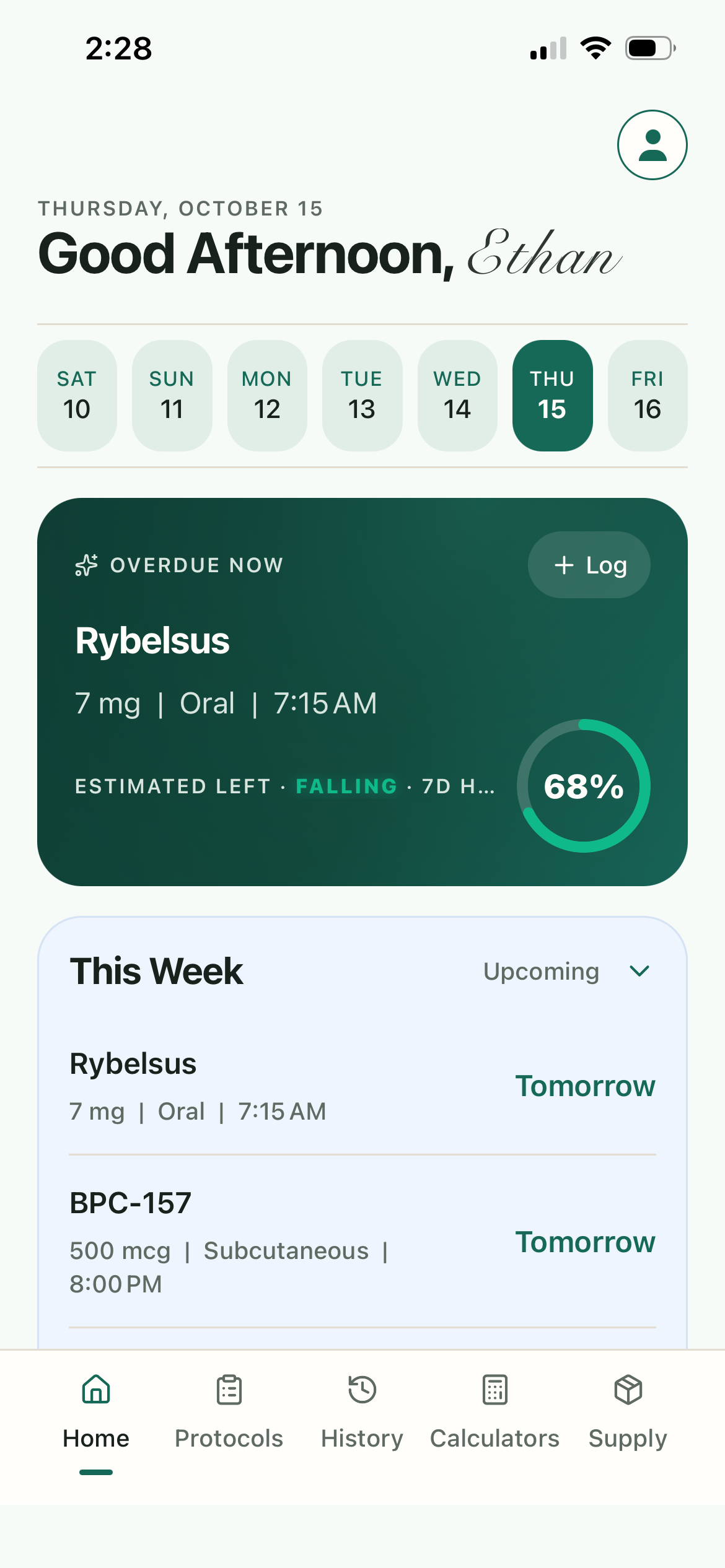
Keep it all together with Protocolit
Protocolit is built to keep your protocols, dose administrations, titrations, missed doses, injection sites, supply, expiration dates, and weight trends together. Leave the routine to us, so you can focus on the journey.

 Coming soon