
Why is my GLP-1 making me burp? Sulfur burps and what helps
Team Protocolit
Published:

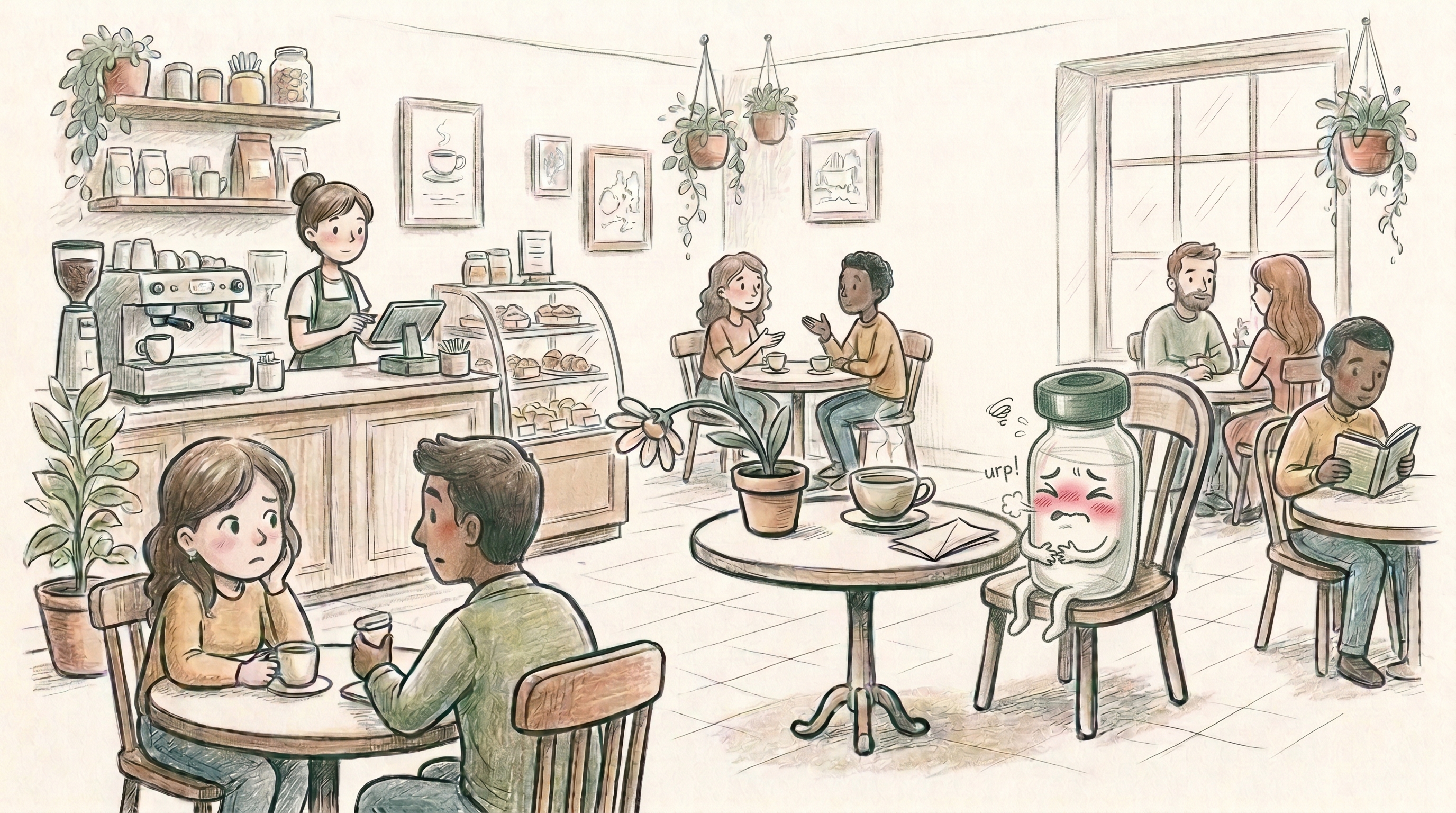
If you have started Zepbound, Wegovy, Ozempic, or Mounjaro and your burps suddenly smell like rotten eggs, you are not imagining it, and you are not the only one.
It is unpleasant and a little embarrassing, but on its own it is usually a sign of slow digestion, not a sign of harm.
This article is for general educational and informational purposes only. It is not medical advice, diagnosis, or a recommendation to start, stop, or change any medication. Talk with your healthcare professional about symptoms that are severe, persistent, worsening, or unusual for you.
Why it happens
GLP-1 medications slow how fast food leaves your stomach. That is a big part of why you feel full longer. The side effect is that food, and the gas it produces, can sit around longer too.
One physician quoted by Inspira Health described it as slower digestion keeping food and stomach acid in the stomach longer, which can mean gas, bloating, or burping.
The rotten-egg smell comes from hydrogen sulfide, a gas produced when sulfur-containing food is broken down in your gut.
Two honest caveats:
- Nobody has a solid number for how common sulfur burps are. Burping, formally called eructation, is a listed side effect for semaglutide and tirzepatide, but trials generally do not record whether the burps smell like sulfur. Belching also showed up among the frequently reported symptoms when University of Pennsylvania researchers analyzed Reddit posts from GLP-1 users, which fits what people say in forums.
- It is not always the drug. How fast you eat, what you eat, constipation, reflux, and infections can all cause gas and sulfur-smelling burps, with or without a GLP-1.
How common is burping on GLP-1s?
The drug labels call burping "eructation." The numbers below are for belching in the listed trial settings, not specifically rotten-egg or sulfur-smelling burps.
| Product and studied doses | Trial setting | People reporting belching | Placebo | US label revision |
|---|---|---|---|---|
| Wegovy injection 2.4 mg | Adult weight reduction | 7% | Less than 1% | June 2026 |
| Zepbound 5 / 10 / 15 mg | Adult weight reduction | 4% / 5% / 5% | 1% | August 2026 |
| Ozempic injection 0.5 / 1 mg | Adults with type 2 diabetes | 2.7% / 1.1% | 0% | May 2026 |
| Mounjaro 5 / 10 / 15 mg | Adults with type 2 diabetes | 3.0% / 2.5% / 3.3% | 0.4% | August 2026 |
| Rybelsus trial formulation 7 / 14 mg | Adults with type 2 diabetes | 0.6% / 2% | 0% | January 2026 |
| Foundayo equivalent doses 5.5 / 9 / 17.2 mg | Adult weight management | 6% / 8% / 8% | 1% | July 2026 |
Do not compare these percentages as a head-to-head ranking. The products were studied in different populations, dose ranges, and trial programs. The useful takeaway is narrower: belching appears in GLP-1 label data, but sulfur odor is not measured separately.
When it usually shows up
Most often in the first weeks of treatment, and it can come back when you move up a dose. That timing is a useful clue.
If it started right after a dose change, it is likely tied to the medication. If it has been months at a steady dose, look harder at food and other digestive issues.
If your symptoms seem tied to a skipped or shifted dose, Protocolit can help you keep symptom notes beside dose timing so you can see whether the pattern repeats. The missed-dose guide can also help you think through timing without guessing.
What people try, in order of effort
- Smaller meals, eaten slower. Your stomach empties slowly now, so a normal-sized meal can sit and ferment. Half portions with a pause in the middle is the simplest change to test first.
- Test the sulfur-heavy foods. Eggs and red meat are common culprits, and cruciferous vegetables like broccoli and cabbage, plus garlic and onions, are also commonly mentioned. Do not just cut protein, though, since protein matters while you are eating less. Swap sources for a week, such as chicken, fish, tofu, or yogurt, and see whether anything changes.
- Cut the swallowed air. Fizzy drinks, chewing gum, and drinking through a straw all add air that has to come back up. Worth cutting while you are testing, whatever the cause turns out to be.
- Check for constipation. If you are backed up, everything upstream slows further and gas builds. If that is you, address that first.
- Ask about the dose. If sulfur burps flare with each increase, talk to your prescriber about slowing the step-up. Some clinical guidance lists slower dose increases as an option.
If nausea is part of the same pattern, start with our GLP-1 nausea guide. Nausea, slow digestion, meal size, constipation, and reflux often overlap.
Do Pepto-Bismol or probiotics help?
Pepto-Bismol contains bismuth subsalicylate, which is why it shows up in sulfur-burp discussions. The evidence is indirect: one small study in healthy adults found that bismuth subsalicylate reduced hydrogen-sulfide release from stool samples, but it did not study burps, GLP-1 users, or rotten-egg belching after injections.
That makes it something to ask a pharmacist about, not a guaranteed fix. Bismuth subsalicylate is related to salicylates, so it can be a poor fit for some people, including those with aspirin or salicylate allergy, bleeding problems, kidney disease, ulcers, or medicines such as blood thinners.
Probiotics are even less specific here. There is no established probiotic strain, dose, or schedule for GLP-1 sulfur burps, and gastroenterology guidance does not recommend probiotics as a treatment for bloating or distention. If you want to test one anyway, treat it like an experiment you track, not something you have to buy to solve the problem.
Keep a two-week log
Write down what you ate, your injection day and dose, and when the burps hit. Patterns show up faster on paper than in your memory: maybe it is always eggs at breakfast, or always the day after the shot.
A log is also something concrete to hand your prescriber. In Protocolit, that same context can live beside your dose history, symptoms, supply notes, and protocol changes.
Use Protocolit to track dose timing, symptom notes, food patterns, and provider-ready history in one place.
Start Tracking TodayWhen to call your doctor
- The burps have not improved within about 2 months of reaching a stable dose.
- They come with ongoing diarrhea, severe bloating, or abdominal pain.
- You cannot eat or drink normally.
Those are the cases where it is worth checking in instead of assuming it is just the medication. And do not stop your GLP-1 on your own because of this. Most digestive side effects can be managed with changes to food, timing, or dose.
FAQ
Do GLP-1s cause sulfur burps?
They can contribute. GLP-1s slow digestion, and burping is listed in prescribing information for some GLP-1 medications. But the specific sulfur smell is not usually tracked separately in trials, and other causes such as food, constipation, reflux, or infection can also be involved.
How long do sulfur burps last?
They may be worse early in treatment or after a dose increase, and may improve as your body adjusts. If they persist after about 2 months at a stable dose, or come with significant digestive symptoms, check in with your clinician.
What foods cause sulfur burps?
Eggs, red meat, cruciferous vegetables, garlic, and onions are common suspects because they contain sulfur compounds or can increase gas for some people. The best test is a short, specific log rather than cutting broad food groups indefinitely.
Do Pepto-Bismol or probiotics help with GLP-1 sulfur burps?
Pepto-Bismol has a plausible sulfur-gas connection because it contains bismuth subsalicylate, but the supporting study was small and did not test GLP-1 users or burping. Ask a pharmacist first, especially if you have salicylate sensitivity, kidney disease, ulcers, bleeding problems, or take blood thinners. Probiotics do not have a proven GLP-1 sulfur-burp regimen.
Sources and further reading
This post was last checked against the sources below on November 16, 2026.
- Inspira Health Network. GLP-1s and Burping: What You Should Know. Read the article.
- GoodRx. Zepbound Sulfur Burps: Causes and Treatment. Read the article.
- Noom. Sulfur Burps: Why GLP-1s May Cause Them and What Helps. Read the article.
- Clinical Nutrition Center. Sulfur Burps with Zepbound or GLP-1 Medications. Read the article.
- University of Pennsylvania School of Engineering and Applied Science. Penn researchers use AI to surface unreported GLP-1 side effects in Reddit posts. Read the article.
- Gastroenterology. Bismuth Subsalicylate Markedly Decreases Hydrogen Sulfide Release in the Human Colon. Read the abstract.
- MedlinePlus. Bismuth Subsalicylate Drug Information. Read the drug information.
- American Gastroenterological Association. Evaluation and Management of Belching, Abdominal Bloating, and Distention. Read the guidance.
About the author: Team Protocolit writes practical, user-centered posts about GLP-1 experiences, medication routines, and research, with an emphasis on making day-to-day tracking easier to act on.