Product form
Record whether your label lists a specific salt or form, because product descriptions can vary and should not be treated as interchangeable.
Peptide tracker
BPC-157 is a synthetic 15-amino-acid peptide discussed around recovery, tissue-repair questions, and digestive-tract research. Keep the research context separate from your own logs, label details, and provider questions.
What is BPC-157?
BPC stands for Body Protection Compound. The name is linked to a larger protective compound associated with gastric juice, while BPC-157 refers to a shorter synthetic sequence discussed on its own.
Product descriptions may use form language such as free base or acetate. A tracker should preserve the exact wording from the label so older notes do not collapse different products into one vague entry.
Benefits and uses researchers are exploring
BPC-157 is best known for recovery. Interest centers on tissues that can be slow to heal, including tendons, ligaments, and muscles. Its connection to gastric juice also led researchers to explore the stomach and intestinal lining.
Here is where the research is concentrated:
BPC-157 users often describe changes in pain, movement, return to training, or digestive comfort. Those experiences explain much of its popularity, while structured measurements make individual recovery stories easier to interpret.
Most published results come from cells and animals, so keep personal notes separate from claims about proven human benefit.
How it works
Researchers discuss several repair-related pathways rather than one simple switch.
Commonly cited themes include blood-vessel growth, tendon-cell movement, fibroblast activity, growth-hormone receptor signaling in models, and nitric-oxide signaling.
Research status
Repair-related changes are mostly described in cell and animal models; human outcome evidence is still limited.
Animal models are often cited, while clinical information remains thin.
Animal safety work is not the same thing as a broad human safety profile.
Dose and forms
Record vial strength, concentration after mixing, storage, sterility context, and who prepared the product.
For compounded BPC-157, keep the prescriber, pharmacy, exact form, route, certificate or quality notes if provided, and prescription-specific instructions with the record.
Record the exact form and the route named on the label, because research from one route does not automatically describe another.
Use the reconstitution calculator only for arithmetic when you already have label details and a prescribed target dose.
Side effects and safety
Keep the product identity, label instructions, logs, and questions attached to the actual record you are reviewing later.
Record whether your label lists a specific salt or form, because product descriptions can vary and should not be treated as interchangeable.
Keep vial amount, opened date, expiration or discard date, remaining supply, and concentration notes together.
Log dates, times, pauses, missed entries, and restarts so the timeline is not rebuilt from memory.
Track where the last administration was recorded and where irritation or site questions came up.
Keep BPC-157 separate from TB-500, GLP-1s, GHK-Cu, or other labels while still seeing the whole routine.
Save side-effect notes, response notes, and questions you want to discuss with a clinician or pharmacist.
Questions
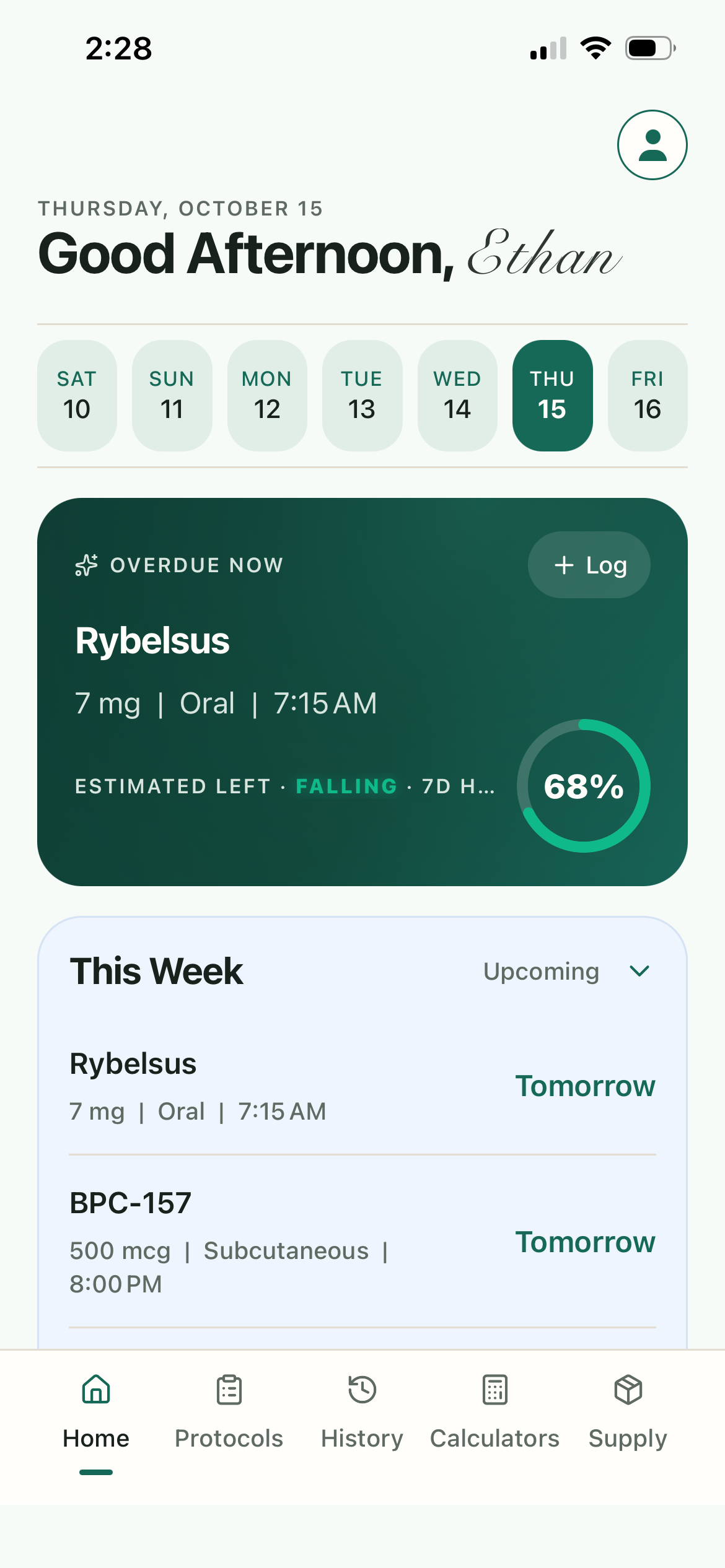
A BPC-157 tracker is a private record for label details, vial context, supply dates, logs, side-effect notes, injection-site notes, and provider questions.
No. Protocolit is for tracking and organization only. It does not recommend BPC-157, choose a dose, source products, diagnose, or make treatment decisions.
Record what is on the label, including total vial amount, form if listed, concentration notes, opened date, discard or expiration date, and any questions for your provider.
Yes. Protocolit can keep BPC-157 notes alongside other peptide or GLP-1 records while keeping each label, supply item, and log easier to review.
No. Protocolit does not sell, source, test, or verify BPC-157 products. It is only a private tracking and organization tool.
Track privately
Keep BPC-157 label details, vial math, dose logs, injection sites, symptoms, and provider questions in one private timeline. Protocolit keeps the record organized without giving medical advice, dosing instructions, sourcing, or treatment recommendations.